

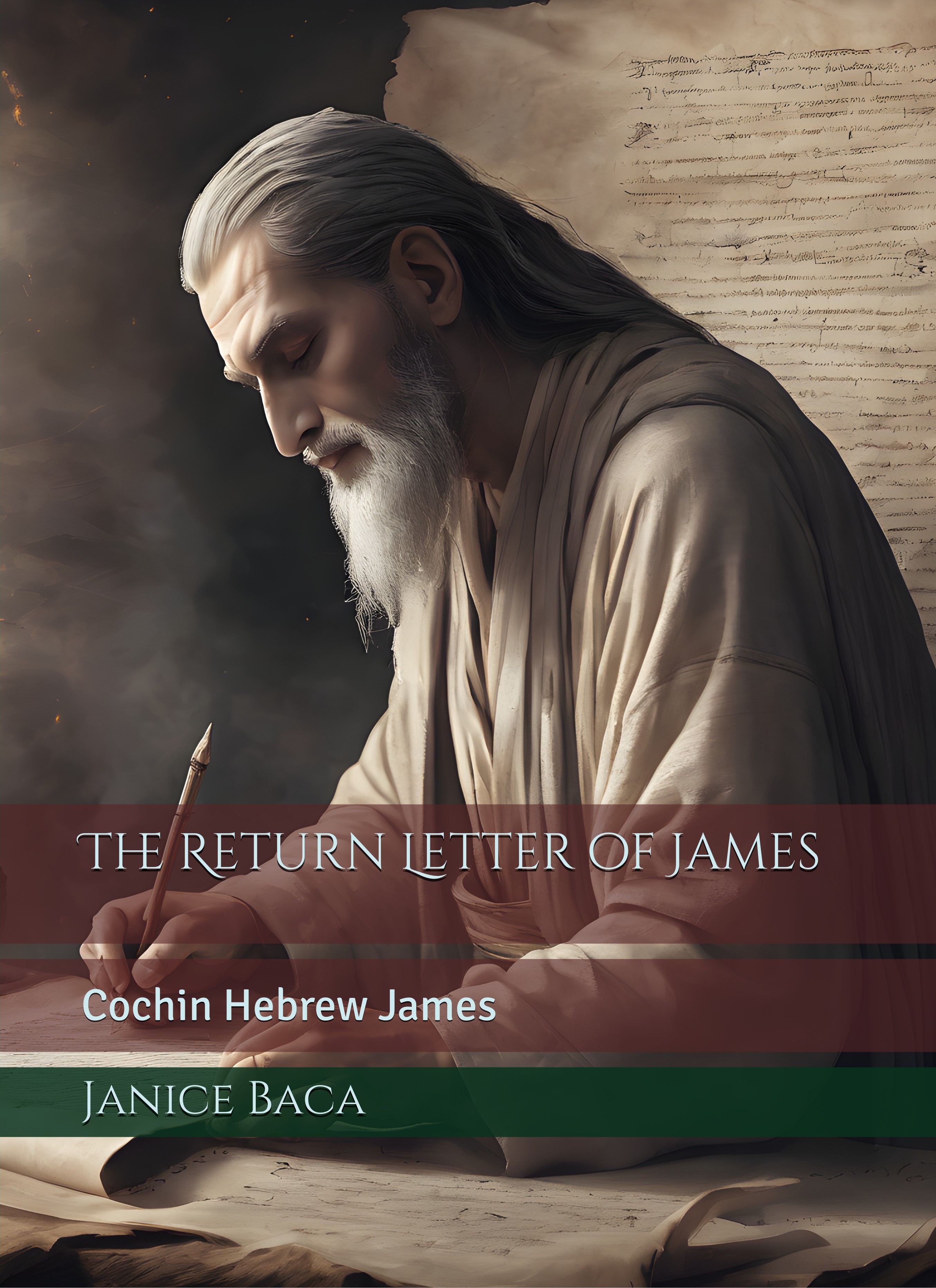
The Return Letter of James: Cochin Hebrew James
Cambridge University Library MS Oo.1.32 English Translation
When the disciples were instructed to take the gospel to the world, two disciples, Thomas and
possibly later, Andrew, took Yeshua’s words literal and made their way to Cochin, India. However, the
earliest information available about the Hebrew gospel is linked to the church established by the apostle
Thomas in India. According to Eusebius, the Gospel according to Matthew had been taken to India by
the apostle Bartholomew [Thomas]… written ’in Hebrew script’ and preserved in India until the visit of
Pantaenus… Jerome repeats this testimony of Eusebius, adding that Pantaenus brought the Hebrew
Matthew with him on his return from India to Alexandria.
Thomas traveled throughout India and was responsible for the establishment of churches in the
state of Travancore, where the city of Cochin is located. In 1803, Claudius Buchanan discovered the
Hebrew New Testament manuscripts in the synagogue of black Jews and purchased them for his
collection. These were later incorporated into the Moses Gaster collection, which was added to the
Rylands Library, and included the MS Oo.1.16.2 and Oo.1.16.1 manuscripts and is now located at the
Cambridge University Library in the United Kingdom.
The Return Letter of James:
The Return Letter of James is a copy of the Hebrew letter written to the scattered twelve tribes of
Israel by James (Yaakov) who was called “the brother of Yeshua” (see Mt 13:55; Mk 6:3). The Return
Letter of James: Cochin James MS Oo.1.32 contains some verses written in Mishnaic Hebrew with
Aramaisms according to the First Century tradition. For it is believed that in the First Century of Judea,
the talmidim (i.e. disciples) spoke rabbinic Hebrew – with a subset of rabbinic Hebrew represented in the
Mishnah called "Mishnaic Hebrew."4 For in the First Century, after the destruction of the Temple in
Jerusalem - and for the following couple of centuries, Mishnaic Hebrew was used and was also included
in the Dead Sea Scrolls. 5,6 The grammar of Cochin James contains verses whose striking differences in
writing style bring a deeper meaning, suggesting that he may have been one step closer to the original
words of James (Yaakov) for the twelve tribes of Israel, scattered abroad for this day.
Complete Book
the-return-letter-of-james-sept-23-2026.pdf (4.1 MB)
The Return Letter of James offers a rare and compelling look at the Letter of James through the Cochin Hebrew manuscript tradition. This volume presents images from Cochin Hebrew MS Oo.1.32 alongside Hebrew transcriptions, English translations, and corresponding King James Version passages for comparison. Translator and Biblical Hebrew grammarian Janice F. Baca invites readers to explore the distinctive language, grammar, and meaning preserved in this manuscript, including Mishnaic Hebrew terms, Aramaisms, and notable translation differences that may illuminate the ancient voice of Yaakov—James, the brother of Yeshua.
More than a translation, this work is a guided encounter with a remarkable Hebrew witness to the New Testament writings. Readers interested in biblical Hebrew, manuscript studies, the Jewish background of Yeshua's teachings, and the message of James will find The Return Letter of James both informative and spiritually thought-provoking.