

All Travel Notes

Jethro’s Tomb

Jethro’s Tomb

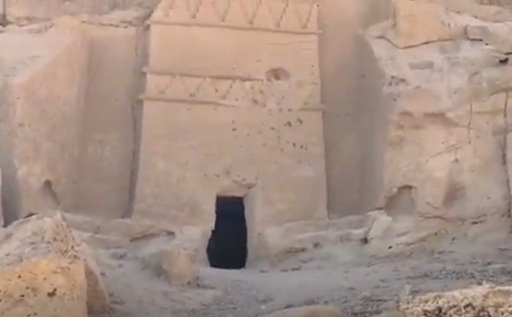
At this location it is known as Mugha’ir Shu’ayb, the Cave of Jethro. Located along the western side of the ancient city of Midian, we have the traditional site of Jethro being buried. There are many things that can be said about this location. One, it is a place where there are many caves. Caves were utilized for the burial of very important people. Jethro was a well to do man for the people of Midian. Two, Josephus records that the Midianites also dwelled in caves. Flavius Josephus, translated by William Whiston, 1960: Josephus Complete Works – Ant. I.xv.1, Josephus uses the word “troglodytis” which means cave dwellers. The Midianites were tent dwelling people who also liked to spend the heat of the summers in caves nearby. At this location there are many caves as the terrain makes it easy for cave structures.


These caves as seen in the pictures were originally living space caves, later many were transformed to make for a granary and then later used for tombs. Later in history around the time these locations were converted to granaries many of these tombs were reshaped into the style of the Nabateans who existed from 300 BC to 106 AD. The Nabatean people were centered on what is commonly known as Petra. The Petra style carving can be observed at the caves of Jethro. Evidence from inside these caves found here dates as far back as to the time of Jethro. Moses prior to the exodus most likely have spent some time in these very same caves. Did Jethro live in these caves and that’s how they got their association? Or was Jethro buried in these caves? Nevertheless, they are in the absolutely correct location for either one or both to be true.


Jethro's Tomb
Jethro's Tomb
Jethro's Tomb
Jethro's Tomb
Jethro's Tomb
 

About the Author

Janice F. Baca

Janice F. Baca

Biblical Hebrew Translator, Project Lead, Author & Speaker

Janice F. Baca is a biblical Hebrew translator, independent researcher, author, and teacher whose work explores Scripture through its Hebrew and broader Semitic foundations. She has completed graduate-level coursework in Theology, Biblical Hebrew, and Biblical Aramaic, equipping her with a strong foundation for advanced study in the languages, texts, and cultures of the ancient Near East.

Her research includes translating the Cochin Cambridge Hebrew New Testament and analyzing other New Testament manuscripts for possible late Second Temple Hebrew markers. This work is shared as a free download through the Project Truth Ministries website, making her research accessible to students, teachers, and readers seeking a deeper understanding of the Hebrew background of the New Testament.

Janice is the author of several published books, including Discover the 144,000: and Their Song; Demons, Devils, Deities: And the Four Witnesses; Power-of-God-Singing: in the Hebrew New Testament; and her newest publication, Cleansing the Soul, the House, and the Land for the Final March. Her translation work also includes book-format editions of the Cochin Revelation, The Scroll of Mysteries: Cochin Hebrew Revelation, and the Cochin Hebrew James, The Return Letter of James: The Cochin Hebrew James, both published on Amazon and available as free downloads through LivingScroll.org. She is also the author of the published paper "The Cochin Hebrew New Testament Manuscripts at Cambridge (MS Oo.1.32, Oo.1.16.1, Oo.1.16.2): Late Copies with Signs of an Early Semitic Tradition," published in the European Hebrew Journal, Vol. 1, No. 1 (2026), where she also serves as the USA Ambassador.

Socials