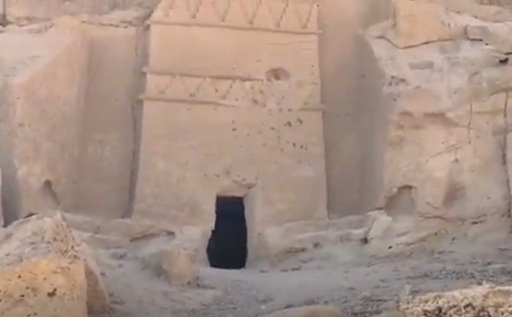

Located in the ancient city of Midian which is today the City of Al-bad, is the traditional well of Moses. There is a strong tradition that Moses lived in this area. This well is located in the northern portion of the ancient city of Midian just under a mile from the caves of Jethro. It is the first well that one would come to along a travel route from the North. This travel route is the main travel route that all people North would have taken if coming from Egypt or Canaan coming to Midian. This well has been dated back to the time of Moses. Could this be the well that Moses got water from when he first came to Midian? Exodus 2:15-16 “When Pharaoh heard of this matter, he sought to kill Moses. But Moses fled from the face of Pharaoh and dwelt in the land of Midian; and he sat down by a well. Now the priest of Midian had seven daughters. And they came and drew water, and they filled the troughs to water their father’s flock. Then the shepherds came and drove them away; but Moses stood up and helped them and watered their flock.” This act of kindness ended up leading to Moses meeting Jethro and then later Moses marrying Zipporah Jethro’s daughter.
Wells and water sources are very sparse in the land of Midian. The region does not get much rain so therefore the wells were common places to meet. If this well is not part of the story of Moses meeting Jethro’s seven daughters then it is certainly a well that he would have visited when he lived with Jethro.
Moses being a Shepherd he would have roamed and utilized all the wells in this area and all surrounding areas. A Sheppard would take his sheep from oasis to oasis, from water source to water source. A Sheppard in this region would also at different times of the year take their sheep to the coast and also to higher ground. There is also a wadi named the wadi of Musa (the wadi of Moses) nearby that leads to the western side of the of Jabal Lawz also known as Jabal Musa (Mountain of Moses). Could this wadi be the wadi that Moses took his sheep to higher ground through that lead Moses met the burning bush on the Western side of Mount Sinai in Exodus 3:2?
 |  | |